Friday, November 17, 2017

"God Uses Our Storms"

Pastor Asha LaRonde and family at their destroyed home
In August and September of 2017 some of the most devastating hurricanes hit the Caribbean and the southern regions of the US. Harvey, Irma, and Maria left hundreds dead, thousands homeless, and cost the US and many islands hundreds of millions of dollars in damage. Our own church members in Florida suffered greatly from the winds and rains of Irma that came in the last days of August. 


Destroyed homes by the hundreds along the road in Dominica
Good and generous church members rose to the occasion and gave hundreds of dollars worth of supplies and dozens of man hours to help clean up the mess left behind in our state. We helped some in our own region clean their flooded homes and help salvage part of their valuables. We carried supplies to the Florida Keys, 8 hours away, to show the love of Christ as well. 


Kim playing with girls in a shelter in Canefield, Dominica
Then in the last week of September, Kim and I boarded a plane with other needed relief and traveled to the islands of Barbados, Dominica, Guadeloupe, and Martinique. We spent 14 days visiting shelters and sharing Christ in churches and schools. It was amazing to see the enduring spirits of the people who had lost so much. Dominica was the island that was affected the most. Most houses were either roofless or a total loss. 


A wonderful group of school kids in Bridgetown, Barbados
While in Dominica, we visited shelter with Pastor Suprian George. He was a young pastor of a church in Canefield. The church in which he served had much of it roof completely ripped off and the damage was extreme. The parsonage where Pastor George and his wife lived was in the upstairs and their narrowly escaped death as 160 mph winds nearly destroyed them and everything they owned. 


A 103 year sweet lady in a shelter in LaPlaine, Dominica
We also, were blessed to cross to the other side of the island and see Pastor Asha LaRonde and his sweet family. They were in despair as their entire house was blown from its foundation. They were and are still currently holed up in the back of their church property which sustained great damage, but was still habitable. Our church along with some nearby sister churches sent chainsaws, tarps, food items, and hundreds of dollars to help both of these men of God and their families. 

While on this trip, Kim and I were blessed to help in a revival on the island of Barbados with our new friend, Pastor Roger Paul. He and his family and members are great people who love the Lord. We were treated with such care  and affection. God blessed in the four islands as I preached 14 times and had 934 souls saved. God is good. He uses even the storms of our lives to help people find shelter under His everlasting wings. 

Kim and I before heading home from Barbados


Saturday, April 1, 2017

Where the Fish are Biting in North Africa

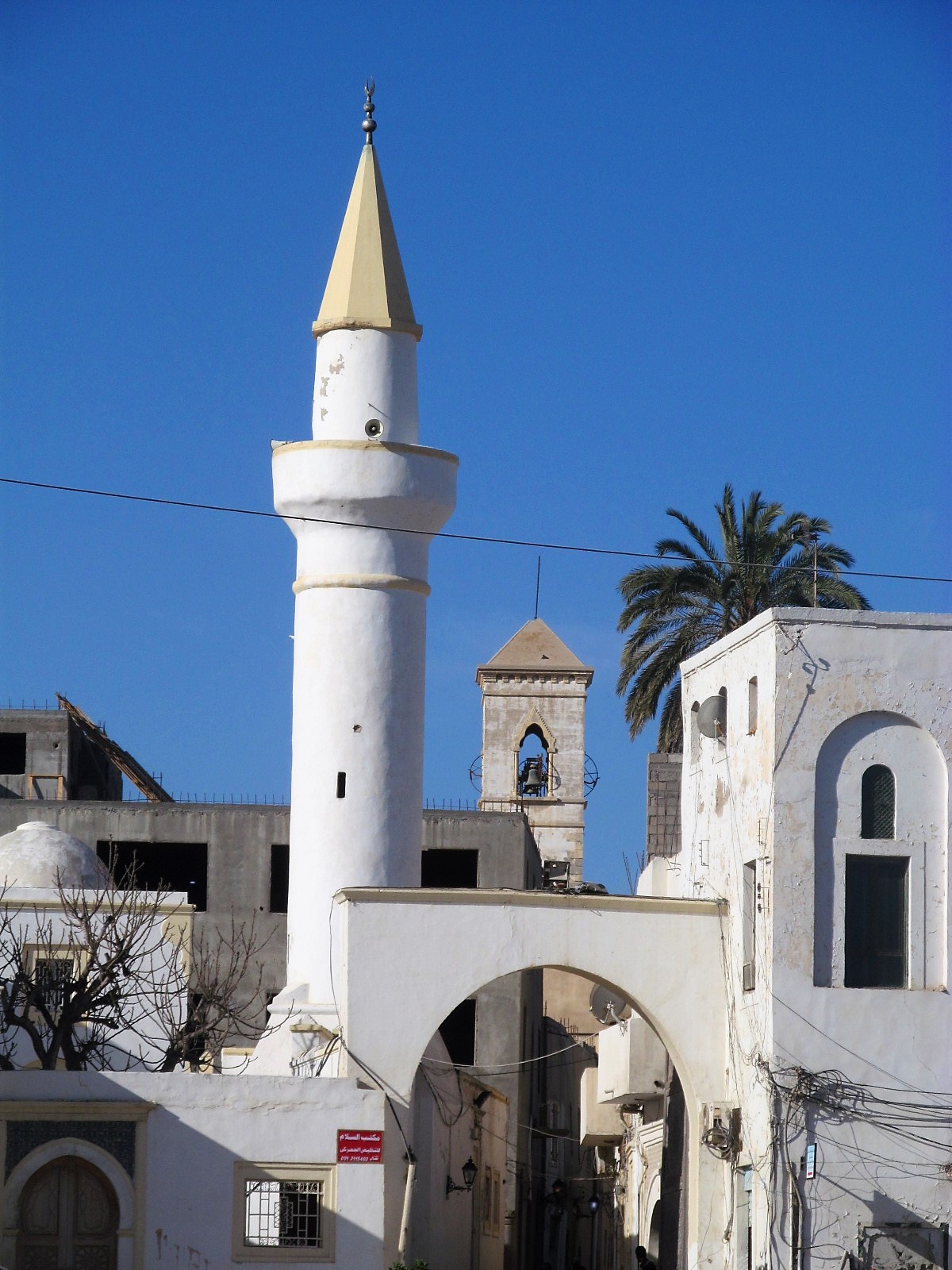
There are those who believe that the Arab World is a place that will never be receptive to the Gospel of Jesus Christ. However, I am not a believer in this line of thinking. It was a man from northern Libya that carried the cross of Jesus in his dying moments. It was to this region of  North Africa that I made my way on a recent trip to sow the seeds of TRUTH. I am not sure who or what fruit will eventually come from my stay in Tripoli, but I am sure that God's Word will never return void. While in Libya, I saw a great need. I along with some whom I ministered with attempted to meet that need.

There is a philosophy that I have sought to live by in doing the work of evangelism. "Go where the fish are bitting". This is what guides me in winning the lost in America, but also, when I am abroad. I search for interest. I search for those in who the Holy Spirit of God is working. I try not to waste my efforts calling those who are afflicted by apathy or even hardness.

So as I walked the streets of this city along the coast of the Mediterranean, I was looking for those in need, but also those who would acknowledge that need. In every 'muslim-strong' culture there are pockets of people in search of truth. As in the days of Cornelius from Acts 10, there are people in spirtual darkness today who long for someone to help them see light. While in Libya, I found some of these.

This pocket of people had come to this region from West Africa in search of a way to migrate into Italy and other parts of Europe. Many had nearly perished crossing the Sahara and had risked all for this opportunity to reach the northern coast of Africa. Most of them had made at least one or more attempts to sail accross the sea, but in each case they had failed. Some had seen fellow immigrants drown in deep waters, while they themselves survived to try again. One dear brother named Newman had made three attempts to cross. Each time he had spent nearly a years savings only to suffer loss. Why had they risked so much? Why were these black Africans here in this Arab land? Last year alone, more than 360,000 had attempted to make it through the troublesome waters for a better life in Europe. An estimated 5000 had died at sea. What could possibly be worth such a heavy risk?

Each one of these souls had a story. Some had come from abject poverty in their motherland. Some had sent their families on before them and were now trying to catch up. Some had gotten stranded in this harsh land for their kind and had turned to prostitution for survival. However, God had brought them to this land for a greater purpose in my opinion. These were the same tribes that I had spent much of my life evangelizing in western and central Africa. These people were some of the most responsive to the Gospel. And so as I was in this place of Tripoli, I found pockets of these migrants and won many of them to Jesus. And it is my belief that they are the link to seeing the Libyan people turn to the Light. These sub-Saharan Africans have learned to speak Arabic and live in the Islamic culture. As born again people, they have the great opportunity and responsibilty of sharing Christ with a people otherwise lost to eternal darkness. The hope for the Libyan people is that their migrant community might be a voice fot Christ. These who came here looking for passage to the Western World could be used by God to bring the message of Heaven to their host nation. God help them to see their divine purpose.


Friday, November 4, 2016

The Land of the Cushites

The grandson of Noah came to this land now known as Sudan thousands of years ago. The descendants of the ark-builder settled in the Nubi mountains and became one of the great kingdoms lead by those often referred to as the "Black Pharaohs". In 400 AD Christian missionaries brought the gospel of Jesus to this region, the roots of which can still be found among the modern tribe called the Moro people. 

I was privileged this past month to preach in the town of Dar el Salaam just north of Khartoum predominately comprised of Moro. It was with my friend, Pastor Angelo Naser. Pastor Naser planted the Brethren Independent Baptist Church a decade ago. He has been a faithful servant of God in this muslim land in spite of the religious persecution many have faced for Christ. Many local pastors have recently been imprisoned and their churches demolished by the Islam-strong government. 

I preached for three days for Pastor Naser and another day taught in a local Bible school. The last night we had more than 500 people in the open air just at the front of the church property where 65 souls came to the Lord. The gospel is going forward in the muslim world. We must not become slack in this hour of decision. We must continue to reach the lost in this arid land. As Noah spared the world from a world-wide flood through his obedience, we must reach his descendants in this day through our sending the message of hope and salvation through Jesus.

The Lamb of God in Egypt

There would be no greater violence than an assassination attempt on our Savior when he was but a young boy. Fleeing to Egypt along the Nile River to escape the fierce sword of Herod came Mary and Joseph with the Son of God. More than three decades before his prophesied death, the anger of a jealous King would send the holy family to Upper Egypt looking for assyluum. For most likely two years they would keep Jesus in hiding in this land of the Pharaohs, before finally returning to Nazareth to live out his childhood.

It was this land of refuge that I would come in October of 2016 to help conduct a three-day  crusade with my friend, Pastor Botros Faltaos. It was a joy to be with Pastor John Wilkerson and Deacon Wayne Shaeffer of the First Baptist Church  of Hammond, Indiana. Each night at the revival just south of El-Minya there was a great crowd ranging from 1100-1400 people. Scores of souls came to Christ as there was an English and Arabic service each evening with great music preceding the preaching. The services were aired on the Arabic TV stations called, "The Way". The last two  evening we had a youth service in conjunction with the adult program. During this time, many young people accepted Christ as their Savior. 

The work of God in Egypt is progressing, but needs the prayers and support of those who can aid this great ministry. Pastor Botros has a part in overseeing more than 4 dozen Baptist churches within the Biblical Baptist Church based out of Alexandria. The pastors he has trained or ordained are scattered throughout Cairo, Alexandria, and Upper Egypt. Pray for this needy land that afforded Jesus a place of safety when he was just a child. Pray that as the Christ child found a place of security in this north African land when he was threatened with violence, so today might he find a place in the hearts of Egyptians where the Word of God is being preached. There are more than 90 million Arab-speaking people in this muslim-dominated country that need to find Christ. The gospel still works in the lives of those who will receive Christ. We must reach them while we can. 

Thursday, April 7, 2016

"Never Too Old"

As I traveled into parts of Africa during the months February and March of 2016, I found a common thread among those with whom I served. It was that several that were serving Christ in some capacity of missions were men and women that had been in the work of God for many decades and were approaching their twilight years.

I was with a dear sweet missionary on the island of Seychelles that represented the best of missions. Her name was Daisy Naicker. She was from South Africa, but of Indian decent. Daisy had spent years in missions both in Fiji and Zambia prior to the death of her husband. Now for several years had being an agent of Child Evangelism Fellowship winning hundreds of children to Christ in this tiny island in the Indian Ocean, I was blessed to minister with her and see all that God was using her to do in spite of her own struggles physically.

Later in my travels, I found myself in the southern region of Ethiopia in a mountainous village sleeping in a mud hut with American missionary, Ray Hoover. We had come to this village of "Ethiopian Jews" to show the Jesus Film and to further explore the possibility of planting a new church. He likewise, had spent many years in missions as well as pastoring in Brooklyn, New York. He had served as a church planter on the island of Malta, and now for the past many years was training nationals and planting churches in East Africa. Brother Hoover and his wife lived very simple lives, sacrificing most comforts for the souls of the Ethiopian people. We slept this night in a place where many Americans would have chosen otherwise. Though the conditions were harsh, this nearly 70 year-old missionary, showed nothing but joy and gratitude to the local people. Many were saved before we returned home to Addis Ababa.

A week later, I found myself on a church platform in Alexandria, Egypt, participating in the ordination service of a young Egyptian preacher. Seated beside me was Bill Grossman, an American missionary that was 86 years of age. He had spent the last many years preaching the gospel in Tunisia as well as Egypt. His wife had passed away after a long battle with Alzheimer's. He wore a tattered jacket as he charged the people in his sermon. He told of being arrested more than 30 times in Tunisia for preaching Jesus on the streets. He was using the years remaining in his life to make a mark for Christ in North Africa.

I have since returned to my comfortable bed in Florida. I jorneyed throughout 6 African nations and more than 20,000 miles. I was blessed to see more than 7,000 souls come to Christ during a 4 week span. I preached in schools, churches, prisons, stores, and the open air. However, one of the lasting impressions on me from this trip to my favorite continent, was not any of the natural beauty I enjoyed, or the hospitality of the African people I met. The most impressionable part of the last month was meeting three elderly missionaries, one in Seychelles, one in Ethiopia, and one in Egypt. It was seeing the charitable spirit of two  men and one woman who had lived into their senior years and yet continued to think of the needs of others. It was seeing them do without for benefit of those they served. I was changed for the good in observing them. I was edified watching their aching bodies muster the strength to go on. I was encouraged to NEVER get "too old" to go on for Jesus!

Wednesday, February 11, 2015

Learning from African Pastors

For the past seven years, I have traveled to various parts of Africa sharing the gospel with hundreds and thousands of people, preaching in churches, schools, prisons, and the open air. I have met dozens and dozens of pastors and church-planters throughout thirty-five African nations. Some of these were American and foreign missionaries, but the vast majority of these were local, indigenous men of God that served in urban areas as well as villages in the remotest places imaginable. I have stayed in their houses, shared rides on public transport for hundreds of miles, eaten meals, and spent thousands of hours serving and communing with them. I have played with their children, listened to their hardships, cried with them, rejoiced with them, fought along side of them, and learned from their experiences. I would like to share with you a few of the lessons I have during these years learned from African Pastors.

The First Lesson that I learned from them is "THERE IS NO PLACE TOO SMALL FOR THE GOSPEL". Many times as Americans we develop a spirit that says, "Send me to the BIG place". Our desire to be noticed and appreciated overtakes our allowing God to lead us no matter where that may be.

I recall being in a small village in southwestern Uganda a few years ago. I was with a simple pastor that had labored in the vineyard for our Lord for a number of years there. He had a church in a small place. The building had a dirt floor, mud walls, and a thatched roof. But he and his sweet wife loved Jesus. He was doing the best he could for our God where he had been planted. He realized that "THERE WAS NO PLACE TOO SMALL FOR THE GOSPEL".

The Second Lesson I learned from these precious men of God is, "BE WILLING TO LEARN FROM OUTSIDERS". As I have spent time in their churches and with their members, I have often brought new ideas, and a methods to reach the lost that before have been unknown to them. On most occasions, they have been willing to try something new in order to accomplish the task of seeing people saved.

However, in my journey's, I have also, attempted to use these same ideas with the local missionary and have found them more often than not to be met with resistance. Why? Why would one be opposed to seeing a person reached through a gospel film show? Why would a Baptist preacher be opposed to preaching in public schools to youth? I am sure that in each case, the particular missionary would have their own reasons. Maybe they just were not the one to think of the idea. Maybe they don't believe in "mass evangelism". Maybe they don't feel comfortable exploring new avenues of ministry. In any case, the African pastor is often willing to learn a new way, while the American will at times not be so eager. Our own culture begets this attitude. However, all of us should walk humbly for the gospel's sake and "BE WILLING TO LEARN FROM OUTSIDERS".

Finally, let me share with you a great lesson that I have learned from these men that every single one of us should learn whether we are in the ministry or not. I learned from my African brothers "TO ALWAYS BE HOSPITABLE TO STRANGERS". In all my African travels, I have only found one African pastor and one African chief to not welcome me into their home and village with open arms. It is taboo within the regions of Africa not to be accommodating to strangers. The idea that you would have someone show up at your church or doorstep and not take time to welcome them, feed them, and inquire about their needs is frankly un-African. Every single time that I have showed up unannounced, I have been met with reception and kindness. I have slept in the pastors and his wife's bedroom, while they slept on sofas and with their children. My being there has at times, I am sure, been unexpected, but never unwanted. I have been an inconvenience, but never made aware of the fact. We, as Americans, could learn alot from the Bible and the African culture on this point. We could learn that in ministry as a Christian, there ought never be "personal zones" when it comes to Christian charity. We should be more flexible and learn how to adapt more freely. We should learn to ALWAYS BE HOSPITABLE TO STRANGERS".


Tuesday, April 8, 2014

"From Burning Churches to A Burning Heart"

I sat in a small room in Djibouti, East Africa, as Guled wept, he told me one of the most amazing and captivating stories of GRACE that I have ever heard. He recalled the events of his youth and how that God had taken this Somalian Muslim and made him into a preacher of the Gospel of Jesus Christ. To be sure, he was not just any Muslim from any part of the Islamic world. He was a fundamentalists from a people who pride themselves as being the "watchman" of the Koran. He was a young and impressionable Somali.
He had grown up in a place called Hargeisa. His father had died when he was still a child, and his mother was unable to care for the needs of Guled and the remaining children. It was a hard life in a hard place. He ended up moving across the border into the eastern towns of Ethiopia. Guled was about 16 years when he and other young teenagers were radicalized by local cleric, and began to spend their evenings burning down church buildings. As we sat and talked in this quiet guest house, Guled said, "I never really knew why I hated Christians and Churches? I just grew up in a culture where it was expected".

Oneday something happened that would change the life of this teenager. An older Ethiopian man offered Guled a place to live, and he spent the next several months living in the home of Christian. The old man cared for him, fed him, and showed a compassion that he had never known from Islam. After being there for several weeks, the man offered him an Arabic New Testament. Guled nearly refused it, but felt compelled to accept it due to the old man's kindness. However, he didn't immediately begin to read it. Then one night he picked up the Bible and after making sure that he wouldn't be seen or found out, he begin out of curiosity to read the Scriptures. He read it nightly, over and over again. He was drawn to the life of Christ and the love of God for people. One evening as he read John 3:16, he could not continue. He was captured by 'God loving the whole world'. Could God love a boy that had burnt churches? Could he love the people of Somalia? Could he even love those that had blasphemed His name? Guled, under the weight of conviction from his own sins, fell to his knees and  with tears begged Christ to be his Savior. For 14 months he had read this Book. He had looked at it with skepticism and so much doubt in the beginning. Now he believed it like a child. Now he believed in the One who died for the sins of every race. He had gone from a Saul of Tarsus, to an Apostle Paul. He had become a Christian, a real Somalian Christian.

Guled travelled back to his home after 4 months of intensive discipleship in Ethiopia. He thought that he might reach his own family with the Gospel. He learned through great affliction that some "come unto their own, but their own receive them not". However, after a period in Hargeisa, through the advise of a man of God, Guled made a decision to go into Djibouti and reach his people in that neighboring country. He came with hardly the shirt on his back, but now, several years later, he conducts Bible studies in a home with several Somalians. He is now married to a good Christian woman and both are serving the Lord. Guled no longer burns churches where people meet to worship the Son of God, but instead his heart burns to serve this same Christ that he once despised.

Thursday, March 28, 2013

Iradukunda!!! 

Iradukunda, the street boy loved by God
While travelling the regions of East Africa this past month preaching the gospel in schools, churches, and open air markets, I was taken to a town in the northwestern corner of Rwanda near Lake Kivu. I was to preach in a church for a Pastor David Hategekimana. After the service was finished, I walked with others back to a nearby bus stop to make our way back to Kigali. It was the late afternoon. While I sat waiting, two young boys walked up and began to watch me as I ate a piece of roasted corn. I was enjoying the corn to the extent that it took a few minutes for me to notice these two street boys. They were raggedly dressed with holes in their shirts and pants. They were both bare-footed and dirty from head to toe. I asked both of them through my nearby translator if they might like a piece of my corn. They quickly agreed. I broke my corn into three pieces and these two boys, most likely ten or eleven years of age, began to devour their own. Sitting in front of the store, I asked if my partner, Adewale, might sing some songs using his guitar to the crowd that was beginning to gather. As he sang the group of young men and boys huddled around. After a couple of songs, I took my Bible and shared the gospel story of grace and love. A little less than thirty of these, including my newly-found street boys, prayed the sinners prayer and trusted Christ as their Savior.


Adewale Sings in Storefront
The crowd dispersed and the the two boys continued standing nearby. I asked the one more destitute-looking, "What is your name?". He replied,  "Iradukunda". I then inquired of his parents. With somewhat of a hesitation in his voice he answered, "My mother has died and my father drove me out of his house once he remarried". "Then where do you sleep at night?", I asked this poor boy. He turned and pointed over the street and described to my translator some outdoor place that he and the other boy used for a shelter. My heart sank as I thought of this homeless child and the hardships that he faced in his day-to-day survival in this East African town. Iradukunda was not alone in his plight of child homelessness. Over 100 million children live on the streets of the world. According to UNICEF, 10 million of these live in Africa.

Iradukunda had now accepted Christ as his Savior. I took him into the small shop which we had sat in front, and bought him a muffin. He sat and ate his muffin quietly. My translator, Rama, asked another older boy some lengthy questions and then gave him some money. The older boy summoned Iradukunda and both left together. I asked Rama where the boys had gone. He stated that older boy was currently working at a car wash, and he had agreed to pay the boy 100 Rwanda Franc or about 15 cents for him to take Iradukunda there and wash his dirty body. I never saw the boys again. Iradukunda had been ushered away for a cleaning of his body. He had earlier received a cleaning of the soul after hearing the gospel.
I boarded a bus with the other men and headed for Kigali. As I sat in the rear of the bus next to Rama I asked, "So what is the meaning of the name 'Iradukunda'?". He replied that it meant "He (God) loves us". As I rode back home that evening I thought of the love of God for all the homeless children of Africa. I thought of His never-ending compassion for those that are rejected by their own. I arrived back at my place of rest. As I closed my eyes on a soft bed after a warm shower I thought of this abandoned boy that I had met along Lake Kivu. I thought of Iradukunda.


Wednesday, March 28, 2012

"Mended by Love"

Last month after preaching throughout southern Africa for four weeks, I discussed with those on our team about the possibility of taking a couple of days prior to returning to the US and going to see the mission that Robert Moffat had established in Kuruman, South Africa, between 1818-70. We all agreed to make the journey, and after 14 hours on the road, we arrived  at the mission on a Saturday. We were able to secure housing there on the property in a nice comfortable room. We then spent all day Saturday, meeting some of the staff and local pastors, as well as visiting the sites on campus that had historical value.

One of the most moving experiences of our stay was musing though the cemetery where men, women, and children who had left their countries behind for the gospel were laid to rest on this distant soil. The names of children will be forever etched in my memory, as I sat alone thinking of mothers who sobbed over the sacrifices they had made for the souls of Africans. I visited the house where the printing press that Moffat that used to print the first of all African Bibles into the Setswana language, a
project that to him more than 30 years. I had an opportunity to preach that Sunday in the old Stone Church that he had built in 1838. I toured a house called the "Livingstone House" where David had come to recuperate from his well-recorded "Lion Attack" in 1845. It was while spending time here in Kuruman recovering from that awful wound that he fell in love with the eldest daughter of Moffat, Mary. It was also, nearby under an almond tree in a lovely garden, that he proposed to Mary, and later that year be wed to her in the Stone Church.
As I spent time reminiscing over all the events that took place over 150 years ago on this hallowed ground, I couldn't help but think of all the hurt that had been felt by those giants of this missionary land. The many heartbreaks that were endured to see the Word of God established in this darkened land were nearly unimaginable. The seeds of the gospel had been watered by the tears of these saints. Then I thought of a wounded Livingstone that had come to this mission to find rest and healing, and had instead found love. He had no doubt over months of recovering found a balm for his body and soul through the tenderness and care of Mary Moffat. He also, found a life-long companion and friend that would complete him and help him to penetrate the interior of Africa with the saving grace of Jesus Christ.

He might have come to Kuruman with a limp, but he left with a leap. He found strength and courage to continue the hard path that God had called him to trek. He had indeed found healing. He was mended by more than simply a doctors medicine, rather he was "mended by love".

Monday, February 13, 2012

"The Influence of One"

In 1820, Robert Moffat would travel to Capetown, South Africa, as a pioneer missionary with the London Missionary Society. Moffat was not from a wealthy or educated home. He had been saved at the age of eighteen and from the outward appearance, had little to offer the world by means of talent. However, he would become known a missionary who had great endurance, and would spend his life winning the lost tribes of Africa for Christ and paving the way for other devoted missionaries to follow.
After settling in a place called Kuruman, Moffat began to develop a burden, not only for the local Setswana people, but he also, had a longing to see the gospel go into the interior of Africa. These were regions where few others ever dared to go. He would at times travel by foot, boat, or oxen hundreds of miles to places like present-day Zimbabwe to share Christ. Moffat cared not what personal cost that he or his wife Mary might pay. They buried their children in the soil of Africa. They suffered attacks by lions and cannibalistic warring tribes. Yet nothing would drive them from this land that so desperately needed Jesus.
In 1839, the Moffats travelled back to Scotland for a brief but productive furlough. On a cold and rainy night, while speaking to a relatively small congregation, he made mention of "the smoke of a thousand villages where no missionary had ever been". A young man that would hear him that evening would answer the call of God in his own life. Visionary, David Livingstone, would join Moffat and family in Kuruman in 1841. While Moffats life would be primarily spent among the Setswana tribe in southern Africa, Livingstone would cut deep into the center of Africa and travel nearly 40,000 miles preaching Christ and discovering new lands.

As a missionary and lover of the African people, I will go this month to share the gospel in places Livingstone once pioneered along the Zambesi River. Our party of four Baptist preachers will speak in churches, schools, and prisons in Gaborone, Pretoria, Bulawayo, Victoria Falls, Livingstone, and Katima. Though it may have been a Livinstone who inspired hundreds of others to converge on these regions and give their lives to the people and cause of Christ, it should be remembered that Moffat first influenced Livingstone. Had there not been the faithfulness of a Robert Moffat, there would never have been a David Livingstone. Thank God for the "Influence of One"

Wednesday, August 31, 2011

Reaching the Unlovely

Last March while in Brazzaville, Congo, my brother and I had the honor of working with Brother Jean-Claude Malanda of Campus Crusade. The Lord used our time to melt our hearts with this choice servant of God and give us a burden for reaching the Pygmies in the Northern Regions of the Congo. The Pygmies number more that 49,000 in this region of Africa and are viewed by other African tribes as being sub-human. God loves the whole world and this certainly would include the pockets of Pygmies throughout West and Central Africa. In March, 2012, our team along with Brother Malanda will be staying for 4 weeks doing evangelism and training of workers in the foundations of Christianity. Please, pray for us to impact these precious people for Christ.  

Wednesday, March 30, 2011

At "Peace" on the Congo River!

On February 14th I embarked on a five-nation evangelistic trip throughout Central and West Africa with my brother, Chris, and Missionary Jeff Stewart. We had no idea the things that would contront us as we travelled by road from Douala to Yaounde to Libreville to Brazzaville to Kinshasa. This 1500 mile journey would take us into some of the most difficult circumstances and terrain that I have experienced in my 14 years of serving the Lord in Africa. We would would preach in schools, churches, prisons, and the open air, and would rejoice as some 6,569 souls would receive Christ as their Savior. Our final stop would be on the Congo River near Kinshasa.
While travelling along this majestic African river, my mind raced to the day when an early Baptist missionary, George Grenfell, came here in 1884 with his steamship named the "SS Peace". Grenfell had helped with the design of it and it's construction a year earlier. It was a 78 foot long iron steamship built from the donation of Robert Arthington Jr. through the Baptist Missionary Society in London. It's purpose was to send the gospel into the interior of Africa by way of the Congo. These deadly waters had become a graveyard for the missionaries due to disease, crocodiles, and ambush from the local tribesmen. The gospel had not been able to penetrate far into the jungles due to these calamities. This was the case until George Grenfell and more than a thousand Africans carried in 800 crates the dismantled "Peace" more than 250 miles from the ocean's coastline to the banks of the river at Kinshasa. It took 13 attempts to reach the Stanley Pool, a place in the river that had a depth of 750 feet. Grenfell also, had another problem as 3 of the engineers sent from England to help in the reconstruction of the steamer all died within months. Greanfell decided at that point, with the help of some Liberian seamen, to do the work themselves. He said later in a journal that this blessed boat was "held together by their prayers".
Once the "Peace" was inaugurated she began for years carry the missionaries up this mighty river, stopping along the way for the preaching of the gospel in villages and ministering to people who before were some of the most destitute heathen of their day. Grenffell faced pratices such as cannibalism and human sacrifice. He continued on his service for the Lord all the way until 1906 when he died more than 3,000 miles up the Congo and was buried in a simple grave.
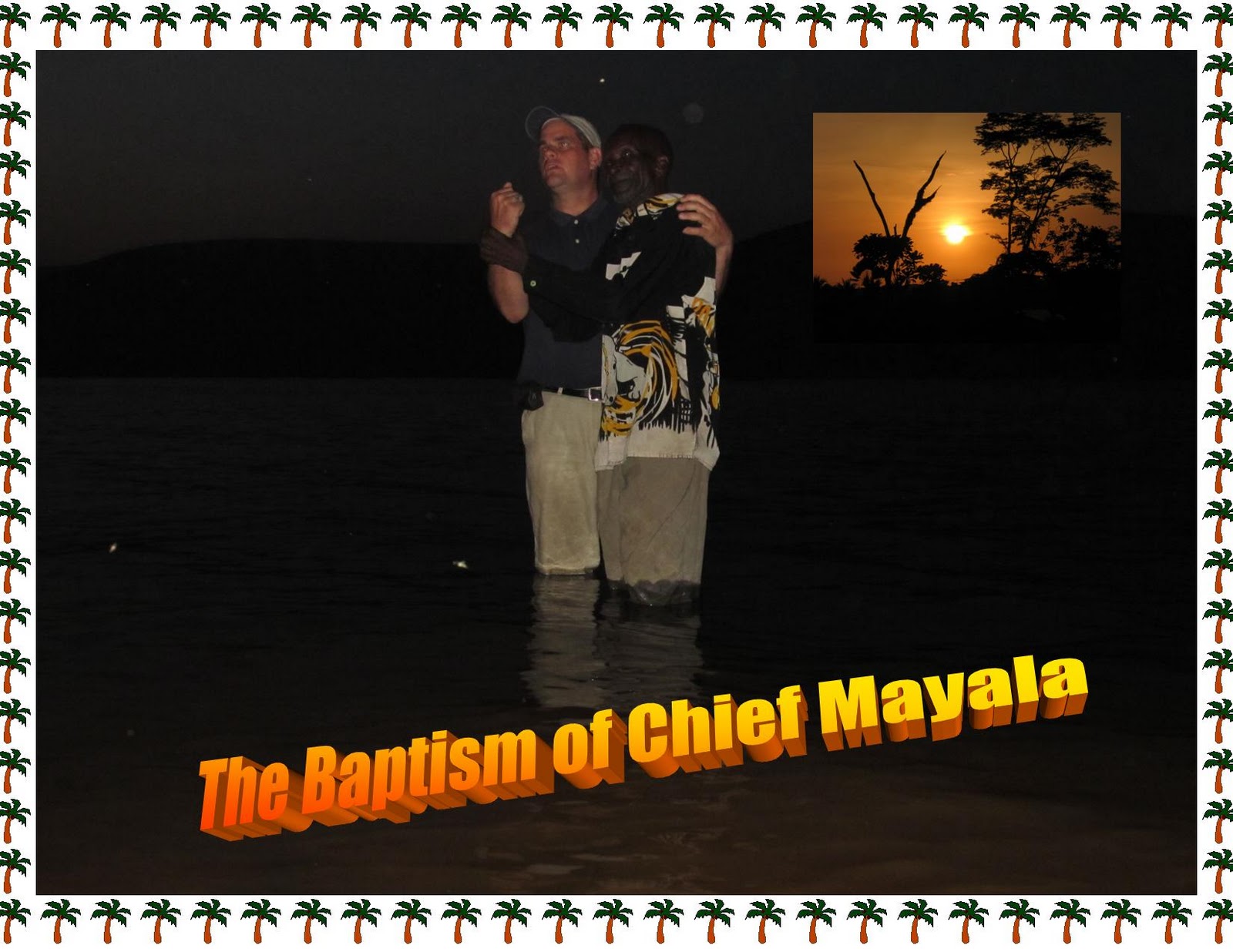
God bless all of those pioneer missionaries who paved a way for those of us who would one day follow. It was on this years eventful journey that we traversed many hours from the place where the "Peace" first entered these murky waters and came by wooden canoe to a village called "Village 19". While at this tiny village, where the people are but simple fishermen and farmers, I had the privilege of leading the local chief, Mayala, to Christ and one evening baptizing him in the river before a group of villagers who had also gotten saved. None of our efforts would have proven a success had it not been for the many sacrifices of men such as George Grenfell.
After more than 3 weeks of ministering in numerous towns and villages, we made our way to Kinshasa to fly back to Cameroon and onto the US. However, we decided to stop over at a place we had heard was the site of where some of the early Baptist had come and where some of the first buildings still stood. We found near the river an old church that was built in 1915. It was unique in and of itself, but when we went further towards the river, what we found what made our ministry there the most memorable of all. It was the original steam engine of the "Peace"! It was sitting just feet from the banks of the Congo and was at the rear of a building in which the Baptist kept century-old photos and documents of George Grenfell and this famous ship! It was truly an amazing day as we had the joy of interviewing the church historian and learning more about the history of the early days of the Baptist along the Congo. We eventually left Kinshasa and made our way back to our church here in Florida. We brought with us as a token of our journey the joys we had from seeing precious Congolese come to Christ, and a deeper appreciation for those who had first brought the "Peace" of God to this region more than 127 years ago!